Cerebral Palsy Did Not Stop This Graphic Designer From Leading a Creative Studio
Arjun Menon's hands move differently than most graphic designers' hands. His cerebral palsy affects his fine motor control, making the fluid mouse gestures that design school teaches — the drag, the click-and-hold, the precise curve adjustment — slow, effortful, and sometimes inaccurate in the traditional sense. What Arjun has built instead is a design process so deliberate, so considered, and so conceptually exact that his work requires less revision than any designer his studio has ever employed. Cerebral palsy professional career graphic design is not a contradiction. In Arjun's case, it is a competitive advantage dressed in slightly different tools.
Today, at 33, Arjun is Creative Director at a mid-sized brand identity studio in Chennai with clients including two national FMCG brands, a fintech startup backed by Sequoia India, and a government tourism board. He leads a team of six designers. He has won three regional design awards. His studio's client retention rate is 94% — the highest in its ten-year history, and every year since Arjun joined.
The Design Mind Behind the Different Hands
Cerebral palsy is the most common motor-related condition among professionals who approach IMAbled's job platform. It exists on a wide spectrum — for many, it affects physical movement while leaving cognition, creativity, and communication entirely intact. For Arjun, the condition affects the fine motor control in his right hand and mildly affects his speech at high fatigue, but has no impact on his visual intelligence, spatial reasoning, colour theory, typography judgment, or conceptual thinking — which are, by any accurate measure, the actual skills that make an exceptional graphic designer.
"People look at my hands and think about the mouse. They should look at my eyes and think about the concept," Arjun says. "Design is judgment. Mouse control is just a delivery mechanism. I have found better delivery mechanisms."
The Adaptive Design Toolkit Arjun Built Over Eight Years
Voice and keyboard-first navigation
Arjun uses Adobe Creative Suite with a heavily customised keyboard shortcut layout, eliminating the need for most mouse operations. He has mapped every function he uses regularly to keyboard combinations and uses a large trackball mouse (rather than a standard mouse) for the fine control moments — a ₹3,200 piece of equipment that transformed his precision. For text and concept development, he uses voice dictation (Google Voice Input on his Mac) to capture ideas at full speed.
Stylus and drawing tablet
A Wacom drawing tablet replaced his mouse for illustration and logo work four years ago. The tablet's pressure sensitivity and the stylus's natural grip position work with his motor pattern rather than against it. His curved, slightly unpredictable strokes — which he once thought of as a liability — became a signature aesthetic quality in his illustration work. Three clients have specifically requested "that hand-drawn quality" in their briefs.
Concept-first workflow
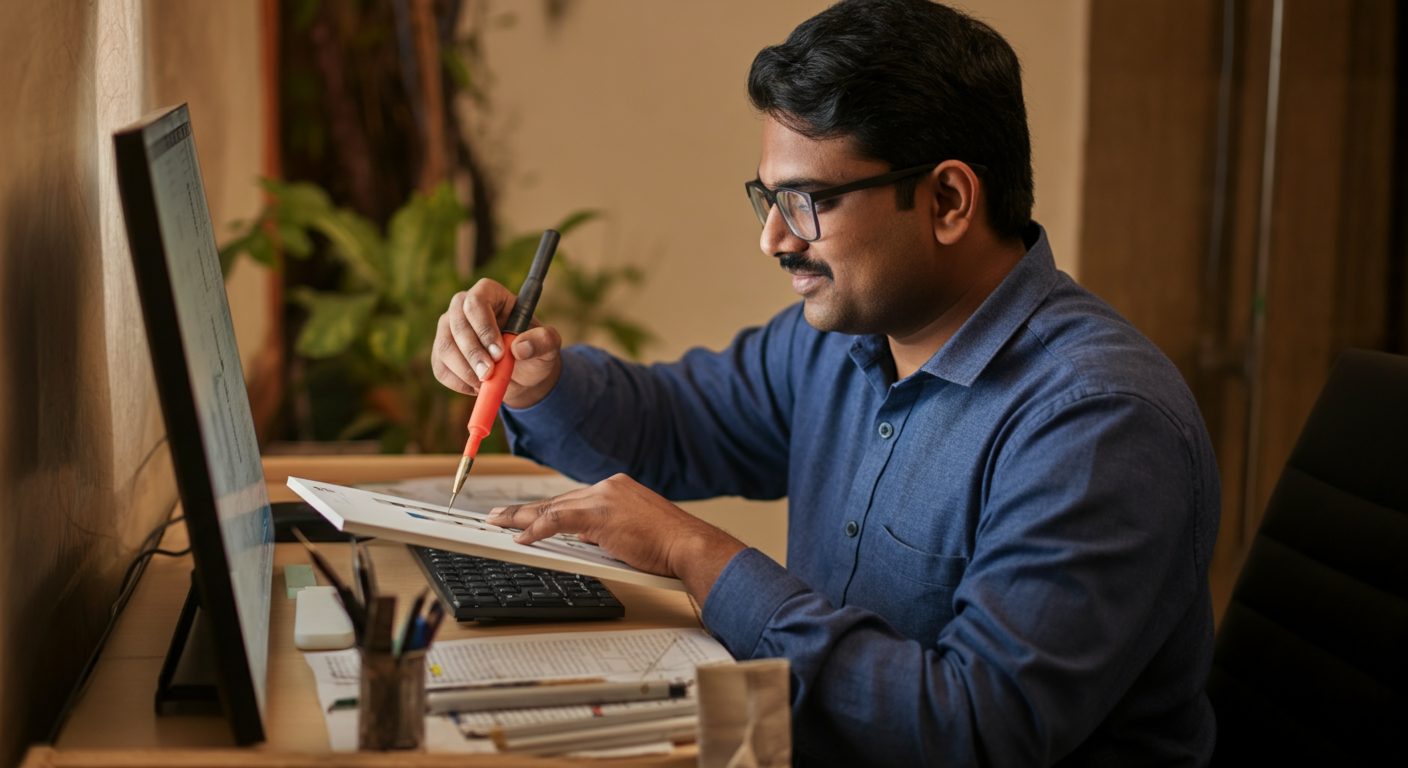
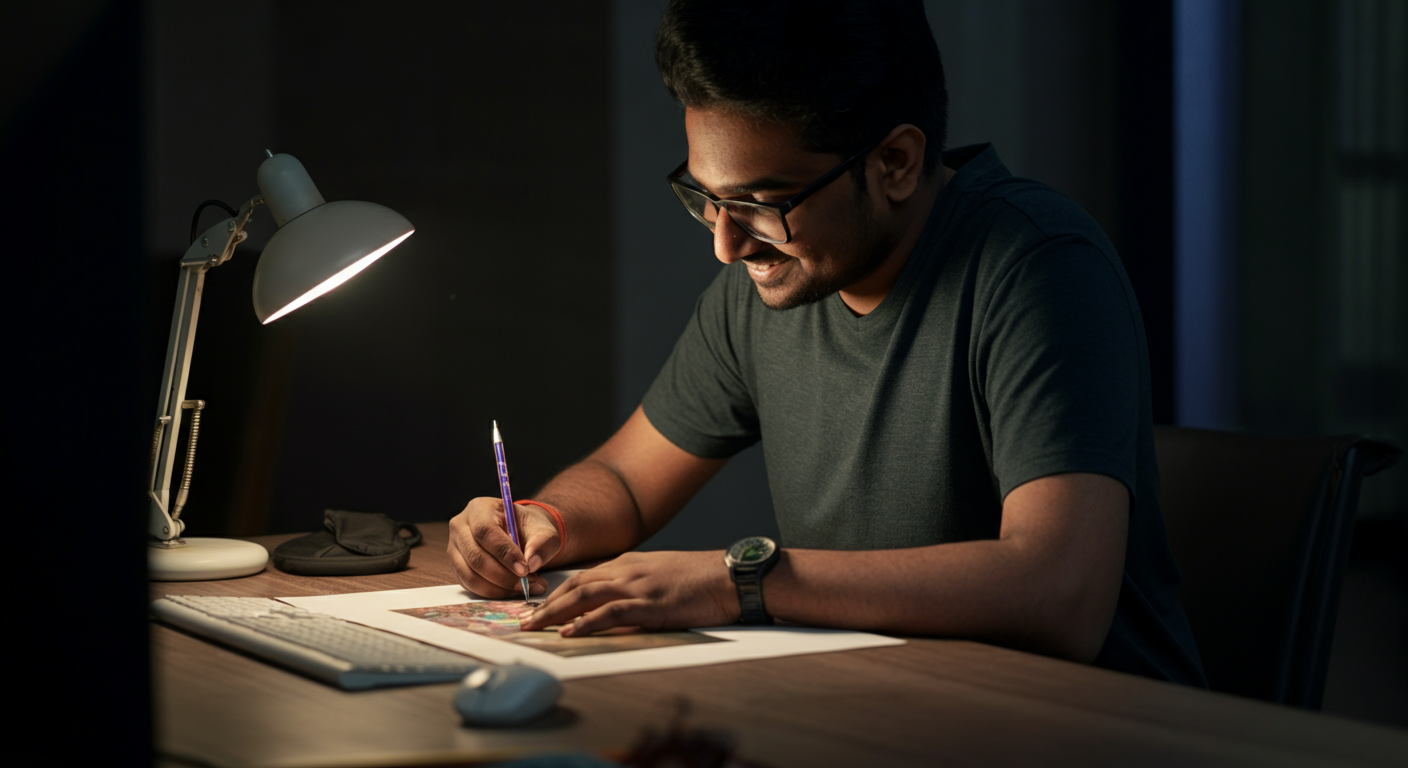
Arjun does more conceptual work on paper (using a thick-grip pen, adapted for his grip) before touching software than any other designer in his studio. "I solve the problem in my head first. When I go to software, I am not exploring — I am executing a decision I have already made. That is faster for me, and it produces better work." This approach has influenced how his entire team works — they now do concept sketching sessions before opening screens, a practice that his studio director credits with reducing client revision rounds by 40%.
Collaboration as a design tool
For complex animation or interaction design, Arjun pairs with a junior designer who handles the precise timeline dragging and frame-by-frame work while Arjun directs. "A film director does not operate the camera. I am the director. My junior is the camera operator. That is not a limitation — that is a professional structure." This model is common in large design studios and advertising agencies globally. Arjun simply formalised it from his first day rather than treating it as an accommodation.
A number worth knowing
According to the Cerebral Palsy Alliance's 2023 workforce research, 78% of adults with cerebral palsy who are employed report that their job requires no physical modification to perform effectively — their CP affects their movement, not their professional output. In knowledge work and creative fields, this number is even higher.
How Arjun Got His First Design Job — and What Went Wrong First
Arjun graduated from a respected design college in Chennai with a strong portfolio. His first two job applications — sent to mid-sized agencies — resulted in interviews that went well until, in both cases, the interviewers saw him work in real time at a design station and grew visibly uncertain. Neither agency followed up. Neither gave a reason.
His third application went to a smaller studio with a founder who had a differently-abled sibling. This founder, Kavitha Rajan, made a single adjustment to the interview: she asked Arjun to complete the design brief on his own equipment, at his own pace, with no time pressure. The result — a brand identity concept for a fictional restaurant — was, by Kavitha's account, the strongest portfolio piece any interview candidate had produced in the studio's five years.
"The brief was: create a premium South Indian dining experience brand. What Arjun gave me was a concept rooted in temple gopuram geometry, using a hand-drawn typeface that felt ancient and contemporary at the same time. The concept was extraordinary. It just took him three hours instead of one. That is not a problem. That is a design budget conversation."
Arjun joined the studio at ₹28,000 per month in 2016. He is now on ₹1.1 lakh per month as Creative Director. The studio's billings have grown 340% since he joined.
What Indian Creative Studios Are Missing by Not Hiring CP Professionals
The creative industry's loss is measurable. Professionals with cerebral palsy who work in design tend to:
- Over-invest in conceptual rigour — because physical execution requires more effort, they think harder before they start, resulting in cleaner concepts and fewer wasted hours
- Build unusually strong directorial skills — experience in articulating their vision to collaborators makes them exceptional creative directors and art directors
- Produce signature visual styles — adaptive tools and techniques often create aesthetic qualities that are distinctive and client-valued, not generic
- Stay in roles longer — the effort required to find an employer who accommodates well creates strong loyalty; Arjun has been with his studio for eight years in an industry where two years is the average tenure
For companies wanting to build ability-inclusive creative teams, IMAbled's employer hub provides a matching service with CP professionals across design, content, and creative strategy roles.
The Simple Equipment Changes That Cost Almost Nothing
For employers reading this: the physical adaptations Arjun needed in his first year cost less than ₹12,000 total.
- Wacom Intuos drawing tablet — ₹7,500 (used) to ₹15,000 (new entry-level); available on Amazon India
- Large trackball mouse — ₹2,500–4,000; ergonomically superior to standard mice for all users
- Thick-grip pens for paper sketching — ₹150 for a 10-pack
- Wrist rest for keyboard — ₹400
- Adjustable-height desk — ₹8,000–18,000; benefits all users
Total: under ₹25,000 for a complete adaptive setup. One client project's additional revenue from having a creative director of Arjun's calibre pays back that investment many times over.
For Professionals With Cerebral Palsy: Your Design Career Roadmap
- Build a concept portfolio, not just an execution portfolio. Show your thinking — mood boards, concept statements, brand strategy documents — alongside finished work. This reveals the design intelligence that matters, independent of production method.
- Know your adaptive tool stack before interviews. Arrive knowing exactly what equipment and software setup you need. Frame it as a production spec. "I work on a Wacom tablet with keyboard-first navigation in Adobe CC" is a professional statement, not a disclosure.
- Target studios with director-model workflows. In larger studios, Creative Directors and Art Directors routinely direct production rather than doing all of it themselves. These environments are naturally built for your working style.
- Connect with ability-aware employers through IMAbled's job listings. Companies listed there have pre-screened for inclusion readiness — you spend your energy on the work, not on educating reluctant hiring managers.
"Every tool I use, I chose. Every workaround I built became a system. Every system I built became a studio standard. That is what designers do — we solve problems. I just started with myself." — Arjun Menon, Creative Director, Chennai
Frequently Asked Questions
Can someone with cerebral palsy become a professional graphic designer in India?
Yes — design is a thinking discipline. Execution tools can be adapted; creative vision cannot be replaced. Drawing tablets, keyboard-first workflows, voice input, and collaborative production models allow professionals with CP to perform at the highest levels. Arjun's Creative Director role is one of many examples across India's design, advertising, and brand identity industries.
What software and equipment help graphic designers with cerebral palsy?
A Wacom or Huion drawing tablet replaces the standard mouse and works with most grip patterns. Customised keyboard shortcuts in Adobe Creative Suite (Photoshop, Illustrator, InDesign) eliminate most mouse navigation. Voice dictation handles text entry. Large trackball mice give more fine-motor-friendly pointer control. The total cost of an adapted setup ranges from ₹8,000 to ₹25,000.
Are there design schools in India accessible to students with cerebral palsy?
Several institutions have improved accessibility, including NID (National Institute of Design) campuses in Ahmedabad and Bengaluru. Many private design colleges in Chennai, Mumbai, and Delhi have begun accommodating students with CP through extended exam time, adaptive equipment, and digital submission formats. Online design programmes (offered through platforms like Coursera and edX) are often more accessible than campus-based programmes.
What creative careers are well-suited to professionals with cerebral palsy?
Graphic design, brand strategy, art direction, creative direction, UX research, content strategy, copywriting, and illustration are all excellent fits. Roles that involve directing rather than executing — Creative Director, Art Director, Brand Strategist — play especially well to the strengths CP professionals often develop: strong conceptual thinking, directorial communication, and deliberate creative judgment.
How should an employer adapt a design role for a professional with cerebral palsy?
Ask the candidate directly what their preferred setup is — most will have a precise answer. Common adaptations include: an adjustable-height desk, a drawing tablet instead of a standard mouse, keyboard-first software configurations, and flexible deadlines that account for task time variability. None of these cost more than ₹25,000 total and all can be discussed as standard onboarding logistics. For guidance, visit IMAbled's employer resource hub.